Government-funded campaigns to promote Pelvic Mesh?
Campaigners are concerned at reports that the UK is set to become Europe’s most important market for pelvic mesh by 2031 – with Government-funded campaigns driving progress.
The stark news comes in a report by experts who predict that profits for female pelvic mesh implant will soar globally from $245 million to $322 million by 2031.
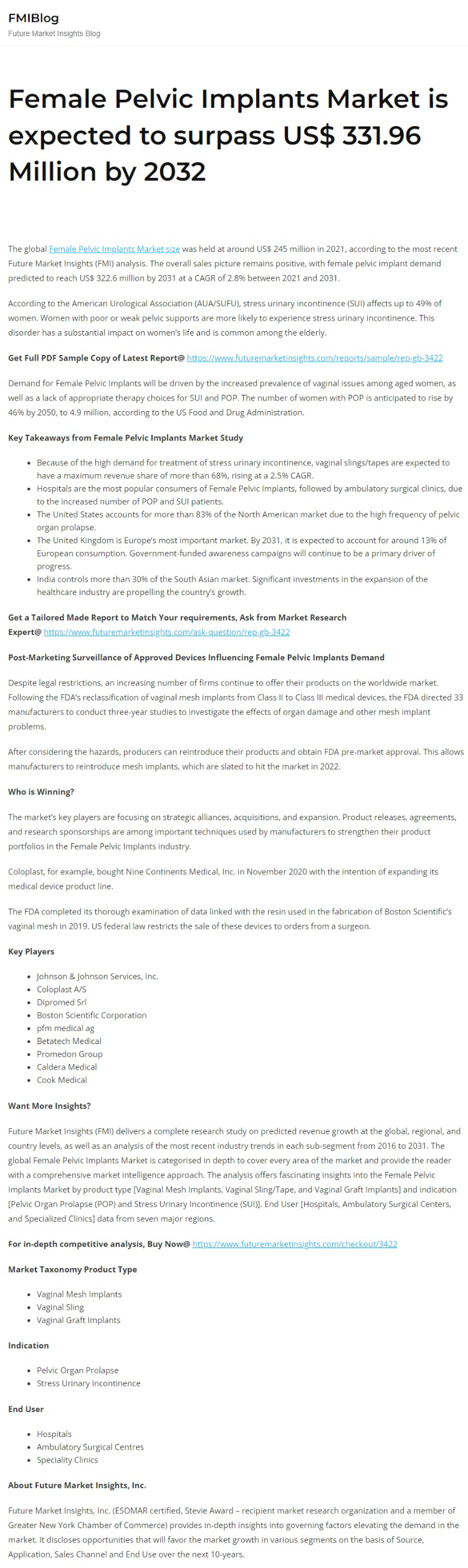
The report, by Future Market Insights, says: “The United Kingdom is Europe’s most important market. By 2031, it is expected to account for around 13% of European consumption. Government-funded awareness campaigns will continue to be a primary driver of progress.”
Sling The Mesh would like to know what these government-funded campaigns entail, where money comes from and to whom is it given, and who agrees the messaging? SEE UPDATE AT END OF ARTICLE
Government funded awareness campaigns around mesh is not something we have heard of until now … unless the messaging is more subtle. Will the campaigns be designed to raise awareness of incontinence and prolapse, with messaging aimed at slowly calling for the lifting of the incontinence mesh sling suspension which has been in place since 2018? If so then yes, we have seen these narratives begin already.
Additional concerns within the FMI report are in a section called – Who is Winning? Here, it is made perfectly clear that industry money is sponsoring new research into mesh products.
Such conflicts of interest have been proven to bias results, by over-inflating mesh benefits and downplaying mesh risks.
The report says: “The market’s key players are focusing on strategic alliances, acquisitions, and expansion. Product releases, agreements, and research sponsorships are among important techniques used by manufacturers to strengthen their product portfolios in the Female Pelvic Implants industry.”
The third concern within the report is a section about stricter regulations in America, where 33 mesh makers were ordered to investigate mesh harm.
“Despite legal restrictions, an increasing number of firms continue to offer their products on the worldwide market,” the report says. “Following the FDA’s reclassification of vaginal mesh implants from Class II to Class III medical devices, the FDA directed 33 manufacturers to conduct three-year studies to investigate the effects of organ damage and other mesh implant problems.
“After considering the hazards, producers can reintroduce their products and obtain FDA pre-market approval. This allows manufacturers to reintroduce mesh implants, which are slated to hit the market in 2022.”
After campaigning for eight years since 2015, it is safe to say the mesh story is a never ending narrative of twists and turns in a giant David and Goliath battle.
- A few days after writing this blog we spotted this article in Forbes with its subtle messaging about new treatments to improve women’s health. The key driver of this is the Government’s Women’s Health APPG which is funded by … industry. We are not against new treatments of course. However, it is vital that patients are fully informed of the risks vs benefits and if they report problems the issues are taken seriously and if there is a trend of harm, that treatment is paused while concerns are investigated.
Screenshot of the FMI blog about the report: