How can they not know? Missing data and half-measures continue to fail mesh-injured women
I asked what I thought was an easy mesh data question. Except nobody at NHS England can answer. Which tells us everything about gaps in accountability.
The question? How many women have had to have part of their bladder or bowel removed because pelvic mesh eroded into their organs? How many are now living with a stoma bag because of these complications?
The answer should exist. It should be easy to find. It should be centrally recorded.
But NHS England says I must ask individual Trusts to gather that data. For reference there are about 200 NHS Trusts in England
Read that again. More than 200 Trusts.
We are talking about some of the most severe, life-changing outcomes possible and there is no national record. Women are instead told that the data sits with individual Trusts, scattered and inaccessible unless someone tries to piece it together manually.
That’s not transparency or accountability.. That’s a system that doesn’t fully see the harm it has caused.
It is particularly galling as there are two NHS websites that downplay mesh harm.
One says ‘most complications are relatively minor‘ and another says only ‘a few‘ women suffer mesh complications. See screenshots below.
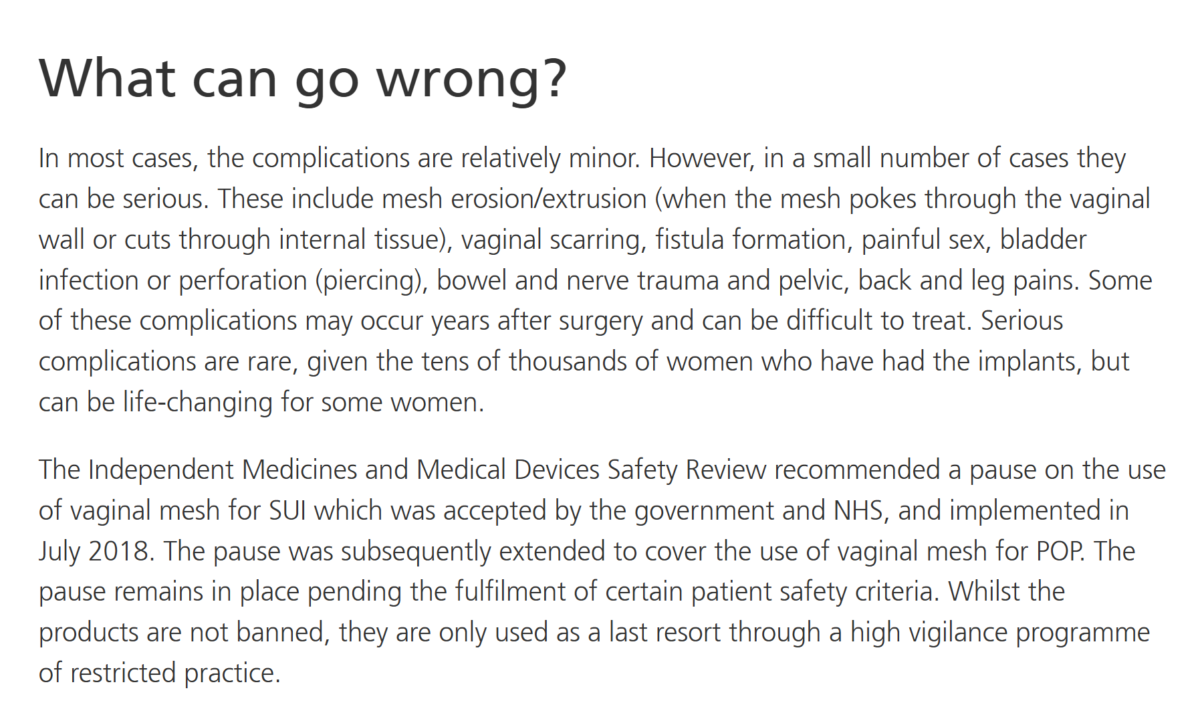
NHS surgery for stress incontinence webpage – doesn’t explain the 2018 mesh sling suspension.
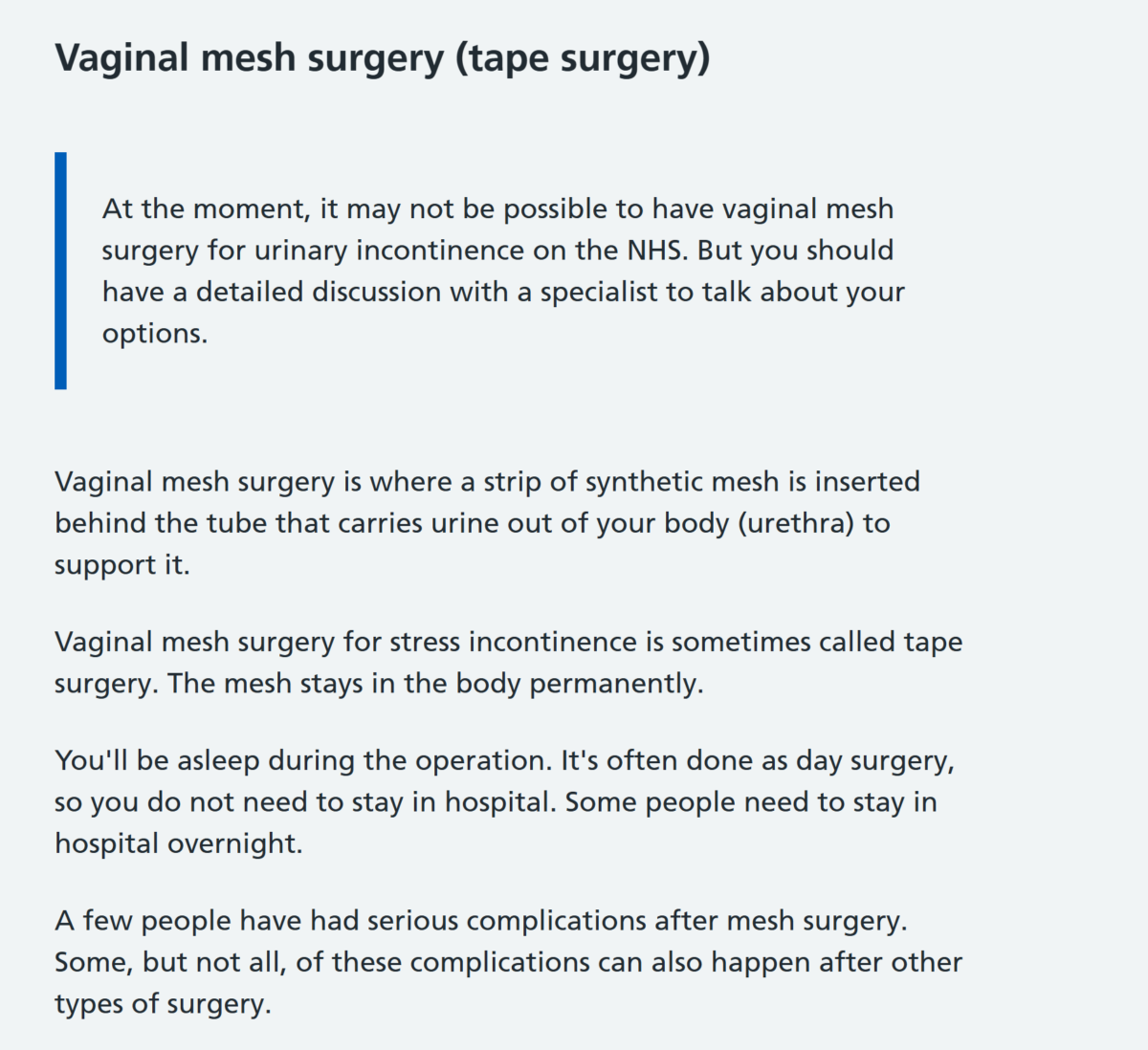
Thousands affected but still no full picture
Since specialist mesh centres officially opened in 2021, nearly 3,000 patients have been referred for complications. That number alone shows this is not rare.
We also know what’s happening when it comes to removal surgery:
- 445 partial mesh removals
- 468 full mesh removals
At first glance, it looks balanced almost 50/50. But that balance is exactly the problem.
Half removals, when women are asking for full
Many women and campaigners have been clear for years: they want full mesh removal wherever possible. Because partial removal isn’t a clean solution. It can mean:
- mesh left behind
- ongoing pain
- continuing complications
- further surgeries later
So why are partial removals happening almost as often as full removals? Why are women still left with incomplete fixes for a problem that has already caused so much damage?
The bigger issue: what we don’t measure, we fail to fix
The most serious harm – organ damage leading to bowel or bladder removal remains uncounted at a transparent national level.
At the same time, treatment outcomes show a system still delivering partial solutions to a serious problem.
Put those two things together and the picture becomes clear:
- We don’t fully know how bad the harm is
- And we’re not consistently delivering the level of treatment many women are asking for
The question that now needs answering
If we don’t even count the worst outcomes and we’re still not consistently offering complete treatment how can this be considered acceptable care?
Freedom of Information Request below
1.How many women have had to have a bladder / and or bowel removed due to complications caused by pelvic mesh
eroding into the organ. It means they now live with a stoma bag. NHS England does not hold this information. This information may be held by the Trusts, as such, you may wish to contact them directly.
2.Please could you tell me how many women have been seen for mesh complications at the UK specialist pelvic mesh centres since the centres officially launched in 2021? Since Mesh Centres launched in 2021, nearly 3,000 patients have been
referred to mesh centres.
3.How many women have had partial mesh removal at UK mesh removal centres
since the centres officially launched? Since Mesh Centres launched in 2021 there have been 445 partial mesh
removals up until March 2025 (latest figures available)
4.How many women have had full mesh removal at UK mesh removal centres since the centres officially launched? Since Mesh Centres launched in 2021 there have been 468 full mesh
removals up until March 2025 (latest figures available)