Many studies into surgical mesh were flawed as they didn’t log pain or complications – they merely logged if the mesh had worked.
Most studies only followed up patients for a few weeks or months, yet surgical mesh can act like a ticking time bomb and take years for complications to show.
The continent patient with debilitating chronic pain developing more than one year after placement is typically considered a treatment success by multiple measures in the majority of scientific literature.
Time and again we saw studies calling pelvic mesh an effective treatment option – yet the authors had focused on the fix and not on any bad outcomes – this was due to using questionnaires that only asked if the mesh had cured bladder leaks or prolapse and either didn’t capture negatives. or didn’t properly capture the full range of complications.
Sadly, in 2025 studies are still being published that repeat those same research mistakes made in the 1990s / 2000s.
Caldera, who recently bought the TVT mesh range from J&J, are enthusiastically plugging bladder slings as a product that “still delivers. In a long-term follow-up study of women who underwent the Gynecare TVT™ Sling procedure between 1998–2003, 76.3% reported significant improvement in their symptoms, even two decades later.” Read the full study here.
🌟 Let’s shine a light on the Study flaws:
1 – There was only a 25% response rate. We don’t know what happened to the other 75% .
2 – It’s an effectiveness, not a safety study. The three questionnaires asked if it worked for stress incontinence. Women were not asked if they’re in pain or suffering sexual problems.
3 – Women were not asked about complications at all! Researchers looked in the case notes themselves. So, there was no Patient Recorded Outcome Measures for complications.
4 – The trial authors looked only in the records in their own hospital. How many women went to a different hospital as they didn’t trust those who implanted mesh in the first place?
Flawed Science
This research from 2013 was used to aggressively promote pelvic mesh globally – the Nilsson Study. It was written by two consultants who were paid by mesh manufacturers! There was only a small number of women in the trial, just 90. At the end of the 17 year study 22% of those women had dropped out – leading to study bias. Women were only contacted to chat on the phone so they were not brought into clinic to fully assess their health and outcomes. The questions focused on the fix and not on new onset of complications.
The Worldwide TVT registrystudy by Tincello from 2011 was used to aggressively market three types of bladder mesh sling. The worldwide registry was funded by Johnson and Johnson = marking your own exam papers. This registry paper was promoted by the International Continence Society even though it failed to highlight three deaths from one type of mesh sling, the TVT Secur.
The Ward and Hilton study compared TVT mesh slings to the traditional native tissue colposuspension. It was used to promote mesh in the UK from 2003. Yet the study had problems that made results unreliable. Many women dropped out after being assigned to the colposuspension. This affected the fairness of the trial and put the TVT bladder mesh in a more favourable light. Also, the study didn’t include enough participants to be able to clearly show if one treatment was better than the other. Finally, the primary focus was if the surgery worked, not if the surgery created new unexpected complications -so it didn’t capture data on lives ruined by mesh.
A key study underlying NICE guidance on the use of rectopexy mesh was authored by Tony Dixon and others- A Multicenter Collaboration to Assess the Safety of Laparoscopic Ventral Rectopexy. This study sets out results for the use of rectopexy mesh in 674 patients operated on at North Bristol NHS Frenchay Hospital. The study claims to have included all patients undergoing laparoscopic ventral rectopexy over a 14-year period (1999–2013). Yet we know many on Sling The Mesh who were never contacted in any follow up.
Dixon – one of his rectopexy studies has been withdrawn and 9 others have expression of concern
The York Report was commissioned by the MHRA in 2012 and cherry picked studies with low mesh complication rates. It also omitted risk of dyspareunia – painful or loss of sex life – to keep the quoted risk figures low at 1-3%. This, despite studies showing that the dyspareunia risk was as high as 16%.
Mesh complication studies existed – but they were ignored
The TOMUS study showed a complication rate of 42% following a mesh sling implant for incontinence – 20% of complications are serious. Yet in their conclusion the authors say mesh is acceptable to use and that most complications resolve without any significant impact. There are 11 authors and only five declare no conflict of interest. Among the non-declared conflicts of interest Gary Lemack received $136,832 in 2013-2015.
Doctors A. Lenore Ackerman and Shlomo Raz say synthetic slings are not safe. Their review shows up to 31% women experience mesh erosion including exposure, extrusion and perforation. The average incidence of erosion is 10.3%.
A review by Ackerman and Razsays most reports only follow up women for six weeks to a year – yet mesh complications can take years to cut in. In one trial (10), a quarter of women experienced significant adverse outcomes by five years after a mesh sling; almost 20% of all women were impacted by chronic pain. Multiple retrospective reviews reveal most complications, especially pain, develop more than a year after placement (11, 16)
This study by Jerry Blavais says at least 15% of women with bladder mesh experience serious adverse outcomes and/or recurrent sphincteric incontinence. A subset of women sustain life-altering complications. Mesh sling complications are under-reported.
This report on degradation of polypropylene is an analysis of meshes explanted from patients. Authors Iakovlev and Bendavid say Mesh degrades and can turn brittle inside the body.
This review by Daniel Rapoport, Howard Fenster, and Jamie E. Wright quotes a figure of 22.3% risk of painful UTIs after having TVT mesh and 19.7% risk of urinary retention. Many women who have a mesh implant suffer chronic urinary tract infections. However, they claim good clinical results can be achieved in the hands of the well-trained, experienced surgeon!
In the American Journal of Obstetrics and Gynaecology AJOG, a study by Abbot et al shows 347 patients sought help for synthetic mesh-related complications; 30% had dyspareunia / lost or reduced sex lives, 42.7% of the patients had mesh erosion and 34.6% had pelvic pain. It says 77% had a grade 3 or 4 (severe) complication.
Hilton and Rose say training surgeons to use mesh is difficult as they cannot see what they’re doing. It is like trying to fix a car’s fan belt without lifting the bonnet. Whilst seductively simple in concept, mid-urethral tape procedures are not without risk; their inherently “blind” nature makes them difficult to teach. The “learning curve” to independent practice may be longer than previously considered.
Serati et al – 30 to 40% risk after prolapse mesh which was critiqued by Daneshgari who said a car with that many problems would be pulled from the market.
How long did it take for UK regulators and government to react?
A timeline of pelvic mesh is in this First Do No Harm report link
In 2000 the SERNIP committee, which looked at safety of medical devices and was replaced by NICE – upgraded bladder mesh slings from C to A meaning safety and efficacy was approved – despite concerns expressed by surgeons on the committee. It was switched as Gynecare (J&J) complained that Classification C would affect European sales.
In 2003 concerns about bladder mesh slings were raised to the Health Technology Appraisal Committee by surgeons. They were ignored.
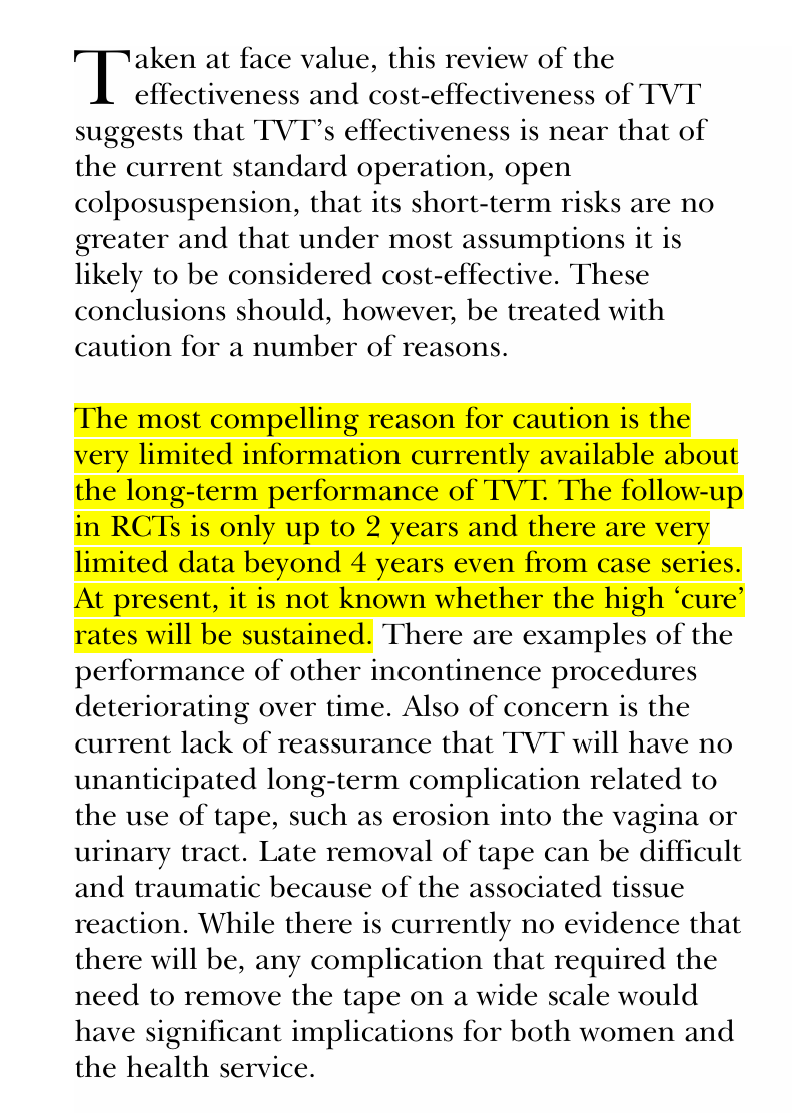
The most compelling reason for caution is the very limited information currently available about the long-term performance of TVT. The follow-up in RCTs is only up to 2 years and there are very limited data beyond 4 years even from case series.
Also of concern is the current lack of reassurance that TVT will have no unanticipated long-term complication related to the use of tape, such as erosion into the vagina or urinary tract. Late removal of tape can be difficult and traumatic because of the associated tissue reaction.
While there is currently no evidence that there will be, any complication that required the need to remove the tape on a wide scale would have significant implications for both women and the health service.
In 2011 mesh injured women met with the NHS to create the Mesh Working Group. They were treated as an unfortunate minority.
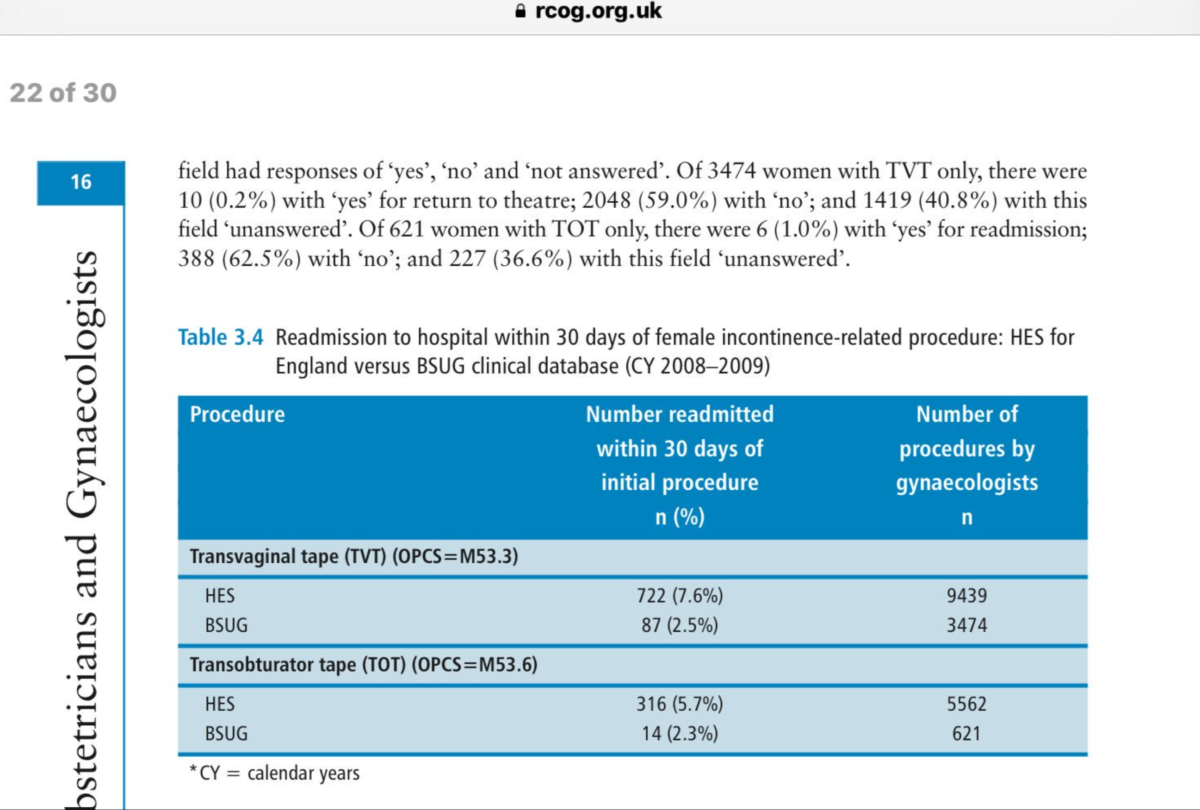
In 2012, the Royal College of Obstetricians and Gynaecologists (RCOG) published its Safety in Gynaecology report. The report included a table based on official NHS Hospital Episode Statistics (HES) data showing that around 1,000 women who had received a bladder mesh sling were re-admitted to hospital within 30 days of surgery with complications. However, data collected by the surgeons’ own organisation, the British Society of Urogynaecology (BSUG), recorded only 101 hospital readmissions by comparison. The large difference between the NHS figures and the surgeons’ data raises questions about the accuracy and completeness of complication reporting. Screenshots of the relevant table are below, as the original RCOG report is no longer available online.
In 2012 the York Report was commissioned by the MHRA. It cherry picked studies.
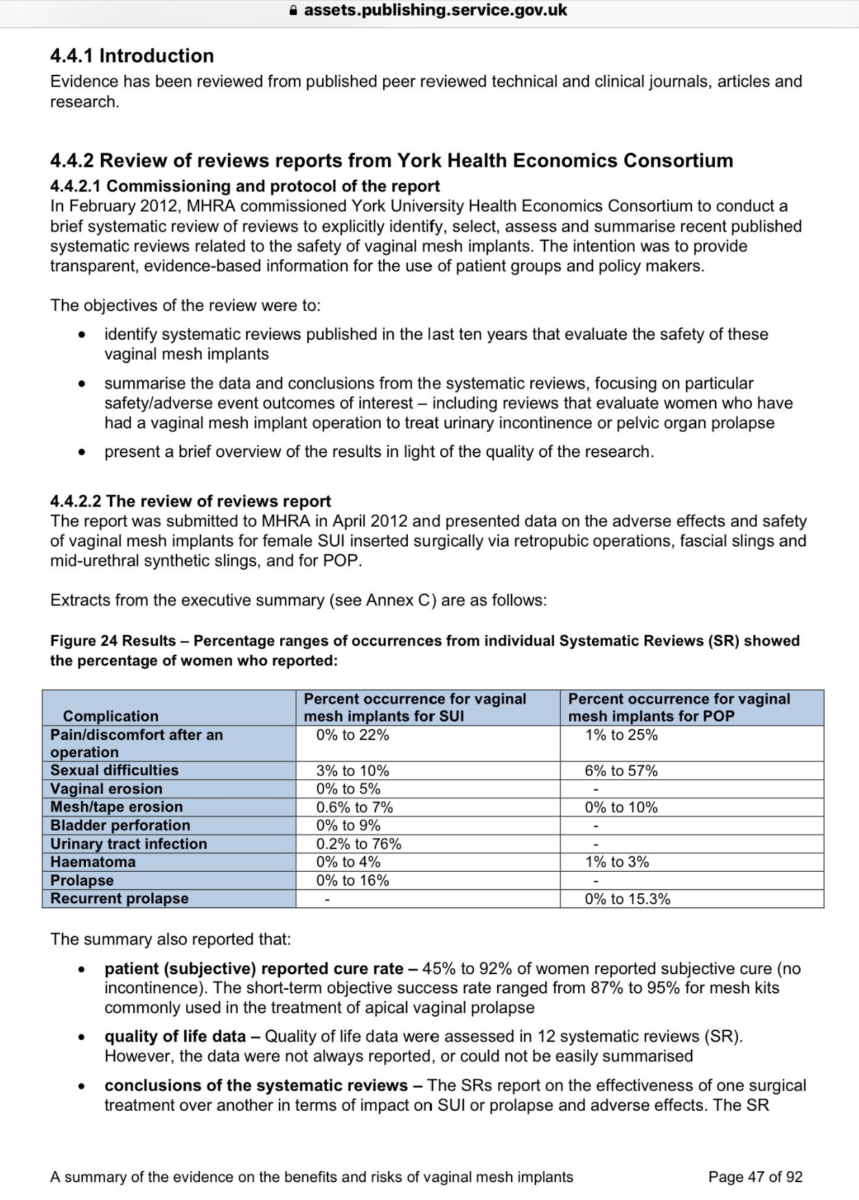
In 2014 the Medicines and Healthcare Regulatory Agency (MHRA) reviewed mesh complications after commissioning the York Report Studies showed risks as 22% pain, 76% UTIs, 7% Erosion. But their report claimed mesh risk was 1-3%. No full safety data on specific devices was made public. The Summary of Risks & Benefits had safety info redacted so manufacturers names & devices aren’t visible. See end of this blog for screenshots showing UTI risk is 76%
In 2015 Sling The Mesh was launched.
In 2018, the MHRA confirmed 3 deaths after incontinence mesh but Drs denied connection. One death involved Bowel Perforation.
In 2018 Baroness Julia Cumberlege suspended bladder mesh slings due to high level of risk. Abdominal prolapse mesh including rectopexy was put on High Vigilance scrutiny. Vaginal prolapse mesh was banned.
2011-12 there were warnings from Patients, the FDA & @RCObsGyn Then 2014 MHRA Summary Risks & Benefits UK Trials reported life changing injuries. A🌏report defining Mesh injuries in 2010-11 No Action til Patients went to Parliament. Reports but No Action@APPGFDNH@MeshCampaignhttps://t.co/dpPLortcIQ
— Fibroid New Research (@FibroidNetwork) July 25, 2025
MHRA report on the Summary of benefits and Risks of Vaginal mesh show complications were known but were not being communicated to women. Look at the outrageously high rate of Urinary Tract Infections of up to 76% of women after a mesh sling. Summary_of_the_evidence_on_the_benefits_and_risks_of_vaginal_mesh_implants.pdf See page 47
Health Technology Assessment report Chapter 8 warns of the risks but Chapter 9 says TVT is a good treatment option!